
(Section 2 of the Jaw Orthopedics Series)
In Section 1, we discussed the incidence of deep bite in growing children and its implications for a child’s development and health. A deep bite relates to the vertical length of the posterior mandible (lower jaw), which also contains the growth (proliferation) zone needed for proper jaw development. Functional jaw orthopedics allows this growth zone to be influenced.
A deep bite or a retruded (backward) lower jaw is not self-limiting, and children do not grow out of it. This is because they are trapped in a vicious circle. The more the teeth wear down, the more they grind, and the process continues. If functional influences have caused the current condition, they must be resolved with functional methods. There are two approaches:
- With functional appliances: For children with multiple jaw problems at the same time, such as a small jaw, crowding, a deep bite, etc.
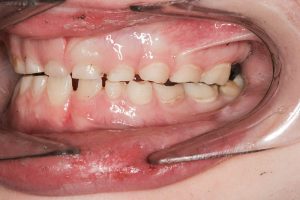
- Without appliances: For children aged 5-8 with a deep bite, if there is no significant arch-size crowding or no retruded lower jaw, a simple bite-opening method can be implemented without appliances. It is also considered a form of interceptive jaw orthopedics, mainly because it repositions the jaw and therefore accelerates growth in the jawbone’s proliferation zones.
It involves adding material to the lower baby (or primary) molars. This increases their height and allows the jaw to close in a vertically open position. This is achieved directly by creating a jig to determine the amount of vertical opening and adding composite on the lower primary teeth.
Another material that can be used is a ceramic polymer overlay on the same primary molars. In the past, we took impressions of the jaws. Today, we do this by digitally scanning the jaws with a wand (for example, a CEREC procedure) and milling four overlays from a more durable, biocompatible material. For parents who are concerned about “plastics” and “BPA-like” materials, this is the way to go. It is costlier, but a sound option. After the overlays are bonded, permanent teeth that erupt will grow to the newly established vertical dimension. By the time the teeth with the overlays are shed (ages 10-12), the functional effect will already be achieved with permanent desired changes to the jawbone.


Q: WHAT ARE THE CONSEQUENCES IN ADULTHOOD IF THIS IS NOT ADDRESSED DURING CHILDHOOD?
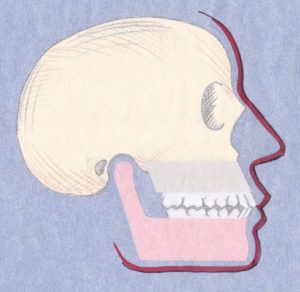
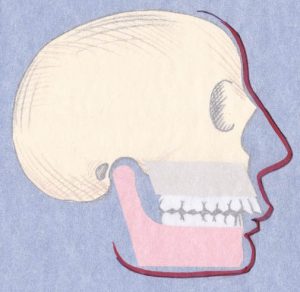
A: Many teens and adults develop crowding, which, by many orthodontists, is resolved by extracting four healthy bicuspid teeth to make “room”. This spells even more trouble as they hit middle age, since these adults develop jaw joint problems, have a flat face with no lip support, and their risk for sleep apnea is increased manifold.
Q: DOES MY CHILD AVOID BRACES IN THE FUTURE IF THIS EARLY INTERVENTION IS CARRIED OUT?
A:. Not necessarily, because other factors may still require braces. However, if needed, the time required will be reduced significantly, and the final outcome will be much better. At this early stage, we focus on the foundation of the jawbone in three dimensions: vertical, lateral (sideways), and sagittal (forward).
More questions are answered on the following page:
This was a very good concise article and something I believe very much. Do you have any reprints I could order. You can reach me at bob.mendel@yahoo.com
Thank you
[…] ← Previous Next → […]