

(Section 1 of the Jaw Orthopedics Series)
An important aspect of children’s dentition is identifying their dental and jaw growth patterns, especially during the rapid growth phase. Here we will concentrate on childhood sleep apnea and its relation to the vertical dimension. This is the arbitrary vertical distance between the upper and lower jaws. If you think of the teeth as columns holding up a room’s roof, then a higher ceiling gives the tongue and airway more room. A small, over-closed space inside the mouth and throat means less airway volume.
Airway means oxygen.
Oxygen means life and growth.
Many children under the age of 8 may exhibit a deep bite, and it is easy for the parent or pediatrician to identify. 80% of jaw growth happens by age 8; therefore, it is reasonable to use this growth-spurt window to treat a dysfunctional growth pattern.
Q: HOW DO PARENTS IDENTIFY A DEEP VERTICAL BITE?
A: Have the child bite down. You will see a deep bite and overlapping incisors: how the front teeth come together when the child bites down. If more than half the height of the lower incisors is covered by the uppers, or if both upper and lower incisors have worn each other down, the child has a deep, over-closed bite.
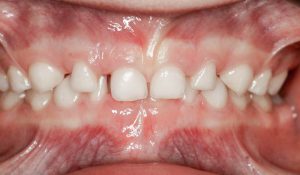
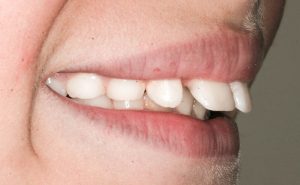
Q: WHAT SIGNS POINT TOWARDS THE RISK OF SLEEP APNEA IN A CHILD?
A: Many of the following signs by themselves may not implicate sleep apnea. However, the more they occur simultaneously, the higher the risk for sleep apnea.
Snoring at night, large tonsils, hyperactivity, dark rings under the eyes, bedwetting, tooth crowding, a reduced vertical bite (see above), and nighttime grinding. Grinding in children is a sign of oxygen deficiency at night. From a jaw orthopedics perspective, these children will also tend to have a retruded (backward) lower jaw, future crowding, and, as they grow up, an unfavorable profile and TMJ problems.


Q: WHAT CAN WE DO IF WE SUSPECT SLEEP APNEA IN OUR CHILD?
A: Many conditions discussed above are not self-limiting, and children will not grow out of them. A constricted dental arch, a vertically closed bite, and a retruded lower jaw do not reverse as a child grows. If the child is treated early enough, between 5 and 8, functional jaw orthopedics can solve most jaw problems. In the case of hypertrophic tonsils and adenoids, these may shrink over the years, but do we take the chance? They are the main culprit in most cases. An ENT specialist has to evaluate the condition and remove them if needed. Many parents swear by it; this procedure can change their child’s life overnight.
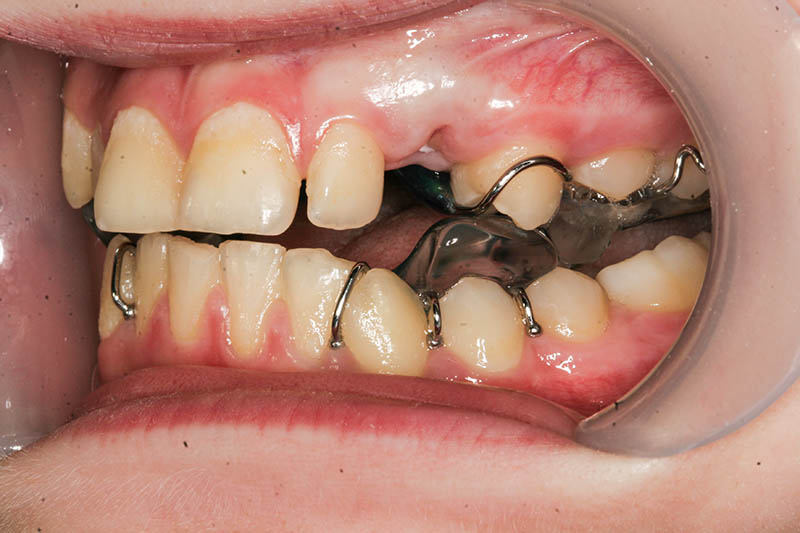
(See also section 2 of this series.)
More resources on childhood sleep apnea and jaw orthopedics: